


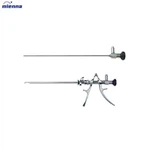
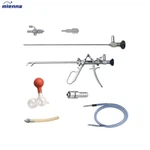


Arthroscopy Forceps
Why choose us?
Mienna:Your Leading Arthroscopy Forceps Supplier
High Quality
We have customized detailed, professional and rigorous production steps. Each product is produced by professional equipment and completed by hand, and finally put on the market after passing numerous inspections and tests.
Advanced Equipment
We have the most advanced equipment on the market, three production lines, to provide customers with efficient and precise solutions, ensuring we maintain our leading position in the fierce market competition.
Professional Team
Our team of experts is always ready to ensure that our products meet the highest standards of quality and safety, and we are always ready to answer any questions or concerns our customers may have.
Rich Experience
We have rich experience and our products have been exported to more than 20 countries and regions



What is Arthroscopy Forceps?
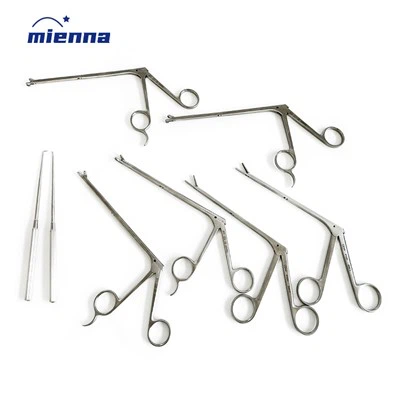
Arthroscopy forceps are surgical tools used to grasp, manipulate, and remove tissue during arthroscopic procedures. They can also be used to remove foreign objects from the surgical site.
Features of Arthroscopy Forceps

Tip shape: Forceps can have straight, curved, or angled tips.
Material: Forceps can be made from stainless steel or aluminum.
Cutting edges: Forceps can have sharp cutting edges for precise resection control.
Ergonomic design: Forceps can be designed to reduce the amount of force required to cut.
Low profile: Forceps can have a low profile tip to make it easier to access tight spaces.
Friction-free: Forceps can have a friction-free coating for a smoother tactile feel.
Quick release: Forceps can have a quick release structure for easy maintenance.
Types Of Arthroscopy Forceps
Grasping forceps
Used to hold and move tissue, and to retrieve foreign objects like stones
Basket forceps
Have an open base that allows tissue to drop free within the joint
Duck punch
A type of arthroscopic forceps
Hook punch
A type of arthroscopic forceps
Arthro scissor
A type of arthroscopic forceps
Suture grasper
A type of arthroscopic forceps
Material of Arthroscopy Forceps?

Stainless Steel: This is a common material due to its strength, resistance to corrosion, and ability to maintain a sharp edge. Stainless steel is also easy to clean and sterilize, which is crucial in medical applications.
Titanium Alloys: Known for their lightweight and high strength, titanium alloys are often used in the manufacture of surgical instruments. They are also biocompatible and resistant to corrosion.
Aluminum: Some parts of the forceps may be made from aluminum due to its light weight and good strength-to-weight ratio.
Polymer Materials: Certain parts of the forceps, especially handles or sheaths, may be made from polymers like polycarbonate or other high-strength plastics that can withstand the rigors of repeated sterilization.
Chrome-Plated Instruments: Some forceps have a chrome plating which enhances their resistance to corrosion and provides a smooth, easy-to-clean surface.
Ceramic Materials: In some advanced applications, ceramic materials may be used for their exceptional wear resistance and biocompatibility.
Application Of Arthroscopy Forceps
Tissue manipulation
Arthroscopy forceps are used to grip, trim, and move tissues

Foreign object removal
Arthroscopy forceps can remove foreign objects that may have entered the surgical site

Stone retrieval
Arthroscopy forceps can grasp and retrieve stones and other foreign matter

Tissue sampling
Biopsy forceps are used to obtain tissue samples for diagnosis
Process of Arthroscopy Forceps

1. Design and Planning:
- Engineers and designers create detailed plans and specifications for the arthroscopy forceps, considering factors such as the intended surgical application, ergonomics, and biomechanics.
- Computer-aided design (CAD) software is often used to create precise 3D models of the forceps.
2. Material Selection:
- As mentioned earlier, materials such as stainless steel, titanium alloys, and polymers are chosen based on their properties and suitability for the specific application.
3. Forging or Machining:
- The raw material is forged or machined into the basic shape of the forceps components. This step may involve cutting, shaping, and polishing the metal to achieve the desired form.
4. Heat Treatment:
- The metal components may undergo heat treatment processes to enhance their strength, durability, and resistance to wear and corrosion.
5. Assembly:
- Individual components are assembled into a complete pair of forceps. This may involve welding, screwing, or other methods of joining the parts together.
6. Finishing:
- The forceps are polished and finished to ensure a smooth surface that is easy to clean and sterilize.
- Any sharp edges are carefully honed to ensure they are safe for use in surgery.
7. Coating or Plating:
- If necessary, components may be chrome-plated or coated with other materials to enhance their properties, such as corrosion resistance or ease of cleaning.
8. Quality Control:
- Each pair of forceps undergoes rigorous quality control checks to ensure they meet the required specifications and standards.
- This may involve visual inspection, mechanical testing (e.g., tensile strength), and functional testing (e.g., opening and closing the jaws).
9. Sterilization:
- Before packaging, the forceps are sterilized using methods such as autoclaving (high-pressure steam), ethylene oxide gas, or radiation to ensure they are safe for use in a sterile surgical environment.
10. Packaging:
- The sterilized forceps are carefully packaged in sterile packaging to maintain their cleanliness until they are used in surgery.
- The packaging typically includes instructions for use and any necessary warnings or precautions.
11. Shipping and Storage:
- The packaged forceps are shipped to distributors or hospitals.
- Proper storage conditions (e.g., temperature and humidity control) are maintained to preserve the integrity of the forceps until they are used.
Components of Arthroscopy Forceps

Arthroscopy forceps: Grasping forceps that can be used to remove loose fragments or stabilize fragments
Arthroscopic camera: A camera with a color monitor that magnifies and illuminates the inside of the joint
Light source: A light system that illuminates the inside of the joint
Shaver: An electrically powered instrument that removes bone
Burr: A soft tissue resecting instrument that oscillates and suctions
Scissors: Instruments used for cutting
Probe: An instrument used for exploring the joint
Arthroscopic knives: Instruments used for cutting
Motorized meniscus cutter: An instrument used for cutting
Maintenance Tips for Arthroscopy Forceps

1. Cleaning:
- After each use, thoroughly clean the forceps with a mild detergent or an enzymatic solution to remove any organic debris, such as blood or tissue.
- Use a soft brush to gently scrub hard-to-reach areas without damaging the instrument.
2. Rinsing:
- Rinse the forceps thoroughly with water to remove any detergent residue.
- Ensure that all parts of the forceps are completely rinsed to avoid any residue that could cause irritation or infection.
3. Disinfection and Sterilization:
- Follow the manufacturer's guidelines for disinfection and sterilization.
- Common methods include autoclaving (steam sterilization), chemical sterilization with ethylene oxide, or low-temperature sterilization processes like hydrogen peroxide gas plasma.
4. Inspection:
- Regularly inspect the forceps for any signs of wear, damage, or corrosion.
- Check the joints, hinges, and locking mechanisms for proper function and alignment.
5. Lubrication:
- Apply a small amount of instrument-specific lubricant to the moving parts of the forceps, such as hinges and joints, to ensure smooth operation and prevent rust.
- Avoid using excessive lubricant, as it can attract dirt and debris.
6. Storage:
- Store the forceps in a clean, dry environment when not in use.
- Use protective cases or storage racks to prevent damage from contact with other instruments.
7. Preventive Maintenance:
- Perform regular preventive maintenance checks according to the manufacturer's recommendations.
- This may include checking for sharpness, ensuring that the jaws close properly, and confirming that the forceps maintain their original shape and alignment.
8. Handling:
- Handle the forceps with care to avoid dropping or misusing them, which can cause damage.
- Use proper technique when passing instruments to avoid stressing the forceps beyond their design limits.
9. Replacement:
- Replace forceps that show signs of significant wear, damage, or loss of functionality.
- Do not attempt to repair damaged forceps yourself; contact the manufacturer or a professional repair service.
10. Documentation:
- Keep a record of maintenance activities, including cleaning, sterilization, and any repairs or replacements.
- This documentation can be helpful for tracking the lifespan of the instruments and ensuring compliance with regulatory standards.
Our factory

FAQS
Q: What is arthroscopy used for?
A: Arthroscopy (ahr-THROS-kuh-pee) is a procedure that uses a fiber-optic camera to diagnose and treat joint problems. A surgeon inserts a narrow tube attached to a fiber-optic video camera through a small incision — about the size of a buttonhole.
Q: What are the features of forceps?
A: They resemble a pair of scissors with the blade replaced by a blunted grip. They also feature a locking mechanism to allow them to act as clamps. Kelly forceps may be floor-grade (regular use) and as such not used for surgery. They may also be sterilized and used in operations, in both human and veterinary medicine.
Q: What are arthroscopic instruments used for?
A: Arthroscopy allows the surgeon to see inside the joint without making a large incision. Surgeons can even repair some types of joint damage during arthroscopy, with pencil-thin surgical instruments inserted through additional small incisions.
Q: How do you clean surgical forceps?
A: Use appropriate brushes to clean each surgical instrument. Use a microbrush to remove debris from the hinged area of scissors, forceps, hemostats, ronguers, needle holders and retractors. Use a microbrush to remove the debris from the box lock area and the ratchet of hemostats and needle holders.
Q: How to clean an arthroscope?
A: Arthroscopes and some instruments for arthroscopic surgery were prepared for use by soaking them for fifteen minutes in a cold solution of 2 per cent glutaraldehyde. This method was practical, economical, safe, and effective.
Q: Can surgical forceps be reused?
A: Reusable medical devices are devices that health care providers can reprocess and reuse on multiple patients. Examples of reusable medical devices include surgical forceps, endoscopes and stethoscopes
Q: Is arthroscope the same as arthroscopy?
A: Arthroscopy is a procedure used to examine the inside of a joint by inserting a thin tube (arthroscope) containing a camera and light through small cuts (incisions) near the joint. The camera sends a close-up video image of the joint to a TV monitor, where the doctor can look at the inside of the joint.