



Thoracoscopy Forceps
Hangzhou Mienna Business Services Co., Ltd.: Your Professional Thoracoscopy Forceps Supplier!
Hangzhou Mienna Business Services Co., Ltd. is a large-scale enterprise specializing in the production and sales of medical products. More than ten years of production and sales have made us a leading comprehensive enterprise with strong R&D strength in the fields of medicine. Our main products include otolaryngology, orthopedics, urology, abdominal surgery, gynecology, disposable related equipment, sports and fitness equipment, etc.
Wide Range of Products
Our main products include orthopedics instruments, otolaryngology instruments, urology instruments, laparoscopy instruments and gynecology instruments. Our products are widely used in the field of medicine.
Leading Service
We have many years of industry experience and a complete production management, quality supervision and sales service operation system. If you want to buy medical products, just send your needs by email and we can respond to you as soon as possible.
Professional Team
As an enterprise that has been tempered for many years, we combine technology and technology to continuously innovate, so that each product is rigorously tested and quality checked.
Complete Qualifications
We have passed ISO quality system certification and CE certification of TUV Rheinland, FDA registration and as well as BSCI audit.
Brief Introduction to Thoracoscopy Forceps
Thoracoscopy forceps are a precision surgical instrument designed for thoracoscopic surgery. They have two long and narrow arms and are used to perform delicate surgical operations under the guidance of a thoracoscope. In thoracoscopic surgery, doctors observe the inside of the chest cavity through a thoracoscope and use thoracoscopic forceps to clamp, separate, cut or suture tissues to achieve treatment purposes.


Features of Thoracoscopy Forceps
High Precision
The design of thoracoscopy forceps enables precise operation under the guidance of thoracoscope, and the doctor can clearly see the surgical area, so as to accurately perform actions such as clamping, separation, cutting or suturing. This high precision reduces the damage to surrounding tissues during the operation and improves the safety and success rate of the operation.
Low Trauma
As a minimally invasive surgical method, thoracoscopic surgery has the advantages of less trauma and faster recovery. As a key tool in surgery, the compact design and precise operation of thoracoscopic forceps further embody the concept of minimally invasive surgery. Surgical operations performed by thoracoscopy forceps can reduce the size and number of surgical incisions and reduce the degree of trauma to patients.
Versatility
Thoracoscopic forceps can be divided into various types according to their functions, such as separation forceps, grasping forceps, suturing forceps, etc. These different types of surgical forceps can meet the needs of various complex operations in thoracoscopic surgery, allowing doctors to choose appropriate surgical forceps for operation according to different surgical conditions. The length, width and material of the forceps arm of thoracoscopic forceps can be customized and adjusted according to surgical needs to adapt to different surgical scenarios and patient conditions. This high adaptability makes thoracoscopic forceps have a wide range of application prospects in thoracoscopic surgery.
Fast Postoperative Recovery
Since thoracoscopic surgery is less invasive, surgical operations performed with thoracoscopic forceps also reduce the patient's postoperative pain accordingly. This helps patients recover their physical functions and quality of life faster. Due to the small surgical trauma and fast recovery, patients can usually be discharged from the hospital and return to normal life and work faster after surgery with thoracoscopic forceps.
High Safety
Thoracoscopic forceps need to be kept sterile during use to avoid cross infection. Doctors will strictly disinfect the forceps before surgery and pay attention to keeping the forceps clean and sterile during surgery. This high degree of aseptic operation requirements ensures the safety of the operation.
Components of Thoracoscopy Forceps
Main Frame
The main frame is the basic structure of the surgical forceps, usually made of high-quality metal materials such as stainless steel or titanium alloy to ensure its strength and corrosion resistance.
Connection Part
The connection part is the connection between the forceps body and the handle or other accessories, designed with a precise thread or snap mechanism to ensure the stability and reliability of the surgical forceps during use.
Arm
Thoracoscopic surgical forceps usually have two long and narrow arms for delicate surgical operations under the guidance of a thoracoscope. The length and width of the arms can be customized according to surgical needs.
Jaws
The jaws are the clamping parts at the end of the arms, designed with various shapes and sizes to meet different surgical needs. The jaws may have serrations, grooves or other special structures to increase the clamping force or facilitate operations such as cutting and separation.
Handle
The handle is the part used by doctors to operate surgical forceps, usually designed in accordance with ergonomic principles, so that doctors can hold and operate them during surgery. The handle may have non-slip textures or control devices such as buttons to achieve functions such as opening and closing, rotating the jaws.
Transmission Mechanism
The transmission mechanism is the component that connects the handle and the forceps arm, and is responsible for converting the doctor's operation on the handle into the corresponding movement of the forceps arm. The design of the transmission mechanism needs to be precise and reliable to ensure the accuracy and stability of the surgical forceps.
Types of Thoracoscopy Forceps

Grasping Forceps
Grasping forceps are mainly used to clamp and fix tissues for other surgical operations, such as suturing and cutting. The jaws are usually designed with a large clamping area and strong clamping force to ensure that the tissue can be clamped stably.

Cutting Forceps
Cutting forceps are used directly to cut tissues or structures such as blood vessels. The jaws usually have sharp blades or scissor-like structures that can precisely cut tissue. At the same time, cutting forceps may also be equipped with a hemostatic function to reduce bleeding during surgery.

Suction Forceps
Suction forceps are used to remove blood, liquid or tissue fragments from the surgical area. The forceps are designed with suction channels and negative pressure devices inside the body to generate suction to suck liquid or tissue fragments out of the body. Suction forceps help keep the surgical field clear and the surgical area clean during surgery.
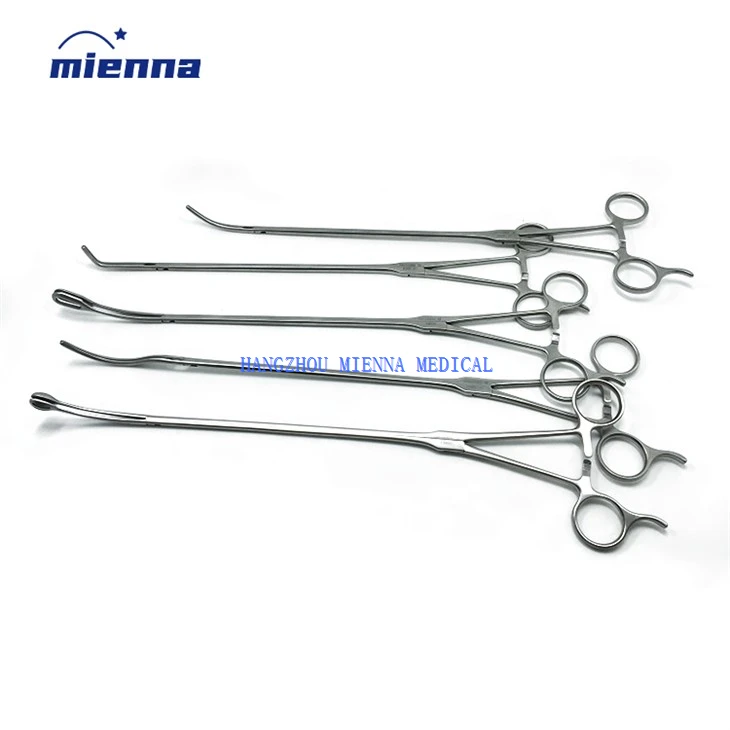
Dissecting Forceps
Dissecting forceps are mainly used to separate and peel tissues to expose the surgical area or perform further operations. The jaws may have sharp edges or serrated structures to better cut and separate tissues. At the same time, the design of the forceps arms also focuses on flexibility and control so that doctors can operate accurately.

Suturing Forceps
Suturing forceps are specially used for suturing operations in thoracoscopic surgery, such as clamping sutures and knotting. The jaws are finely designed to firmly clamp sutures and facilitate doctors to tie knots. In addition, suturing forceps may also have special bending angles or shapes to meet the needs of different surgical sites.

Specialty Forceps
Specialty forceps are special surgical forceps designed for specific surgical needs, such as lymph node dissection forceps, vascular forceps, etc. These forceps usually have special shapes, sizes or functional characteristics to meet the needs of specific surgical sites or surgical operations. For example, lymph node dissection forceps may have finer jaws and stronger clamping force to better clamp and remove lymph node tissue.
Surgical Requirements
Different thoracoscopic surgeries may require different types of surgical forceps. For example, lymph node dissection surgery may require dedicated lymph node dissection forceps, while vascular surgery may require vascular forceps with hemostatic function. The size, shape, and depth of the surgical site will also affect the choice of surgical forceps. Doctors need to choose surgical forceps that can accurately reach and operate the surgical site.
Material And Durability
The material of the surgical forceps should have good durability and corrosion resistance to ensure stable and reliable operation during surgery.
Jaw Design
The design of the jaws should adapt to surgical requirements, such as clamping force, cutting effect, hemostatic function, etc. Doctors need to choose surgical forceps with appropriate jaw design to meet surgical requirements.
Flexibility And Control
The arms of the surgical forceps should have good flexibility and control so that doctors can operate accurately.
Safety And Comfort
The surgical forceps must be kept sterile to avoid the risk of infection during surgery. Doctors need to choose surgical forceps that have been strictly sterilized. The handle design of the surgical forceps should be ergonomic so that doctors can hold and operate comfortably during surgery.
How To Maintain Thoracoscopy Forceps?
Gentle Operation
During the operation, medical staff should gently pass and use surgical forceps to avoid collision with other instruments to avoid damaging the surgical forceps.
Keep Clean
During the operation, surgical forceps are easily stained with blood or the lens is fogged due to temperature difference, affecting the clarity. At this time, medical staff should promptly remove blood stains, wipe and preheat the lens to ensure the clarity of the surgical field.
Thorough Cleaning
After the operation, the blood stains and residues on the surgical forceps should be carefully cleaned. In particular, the joints and the inside of the lumen of the surgical forceps should be carefully cleaned to ensure that there is no residue.
Avoid Bending
Pay special attention not to bend delicate parts such as optical fibers into sharp angles to avoid breaking.
Dry And Oil
After drying the surgical forceps with clean gauze, a thin layer of protective oil can be applied to its surface to prevent rust.
Regular Inspection
Regularly inspect the surgical forceps, including joint flexibility, forceps tooth bite, scissors sharpness, etc. If any problems are found, they should be repaired or replaced in time.
Frequently Asked Questions